
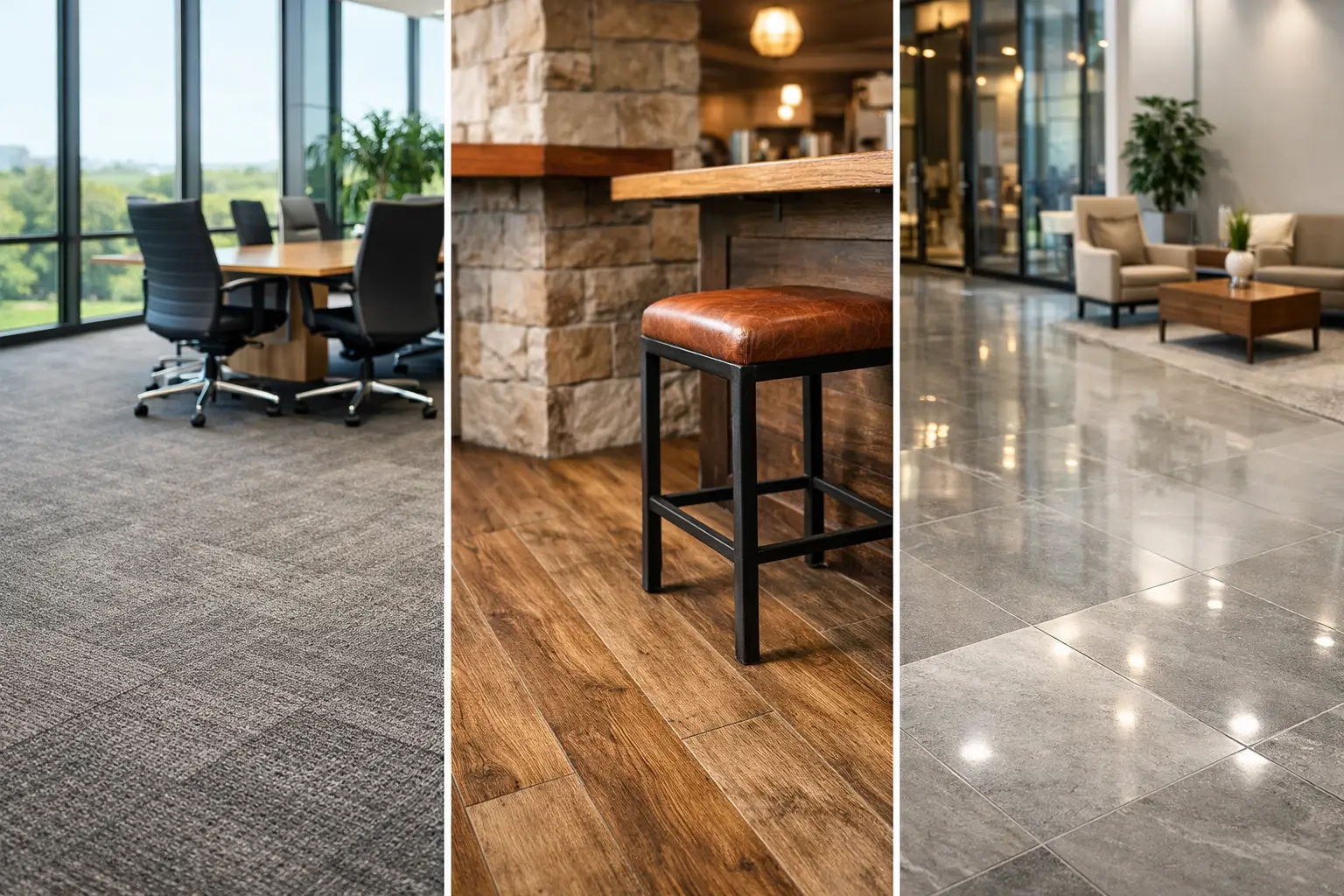
A commercial floor has to handle more than foot traffic. It carries rolling carts, moving furniture, spills, cleaning chemicals, Texas heat, and the daily impression your business makes on customers and employees. The best commercial flooring options balance those realities without forcing you to choose between durability and a space that looks thoughtfully designed.
For business owners, property managers, and developers across Central Texas, flooring is a long-term operational decision. The right material can reduce maintenance demands, support safer movement through the building, reinforce your brand, and make a retrofit or new commercial space feel complete. The wrong one can show wear early, complicate cleaning, or become an expensive disruption sooner than expected.
Start With How the Space Actually Works
Before comparing samples, look at the conditions your floor will face every day. A polished retail showroom, a busy medical office, a restaurant kitchen, and a warehouse may all need commercial-grade flooring, but their requirements are completely different.
Traffic is the first consideration. Identify where people enter, queue, walk, sit, turn carts, and move equipment. A floor that performs well in a private office may not hold up at a busy reception desk or retail entrance. Consider the weight and movement of shelving, forklifts, rolling chairs, pallets, service carts, and cleaning equipment as well.
Central Texas conditions deserve attention, too. Concrete slabs can transmit moisture, particularly in older buildings or spaces with prior water issues. Strong sunlight through storefront windows can fade certain materials over time. An experienced contractor will evaluate the existing subfloor, moisture levels, floor flatness, and transitions before recommending a finished surface. Proper preparation is what allows a quality flooring system to perform as designed.
Best Commercial Flooring Options by Use and Performance
Luxury Vinyl Tile and Plank
Luxury vinyl tile, often called LVT, and luxury vinyl plank, or LVP, remain popular choices for offices, retail stores, clinics, multifamily common areas, and hospitality spaces. They offer a wide range of wood, stone, and concrete-inspired visuals while providing a warmer, quieter surface than ceramic tile or polished concrete.
This material works especially well when appearance matters but the space still needs reliable durability. Quality commercial-rated vinyl resists everyday scuffs and stains, and individual planks or tiles can often be replaced if an area is damaged. It is also more comfortable underfoot for employees who stand for long periods.
The trade-off is that not all vinyl products are equal. Wear-layer thickness, installation method, adhesive quality, and subfloor preparation affect performance. In high-traffic environments, choose a commercial-grade product rather than a residential option that only looks similar. Moisture mitigation may also be necessary over concrete slabs.
Polished Concrete
Polished concrete is a strong fit for modern offices, breweries, showrooms, restaurants, galleries, warehouses, and industrial-style retail settings. It creates a clean, contemporary finish while using the building’s existing slab as the finished floor. When installed correctly, it is exceptionally durable and can reduce the need for replacement materials over the life of the space.
The visual range is broader than many owners expect. Concrete can be polished to different sheen levels, dyed for color, scored for pattern, or finished with exposed aggregate for character. It also supports an open, spacious feeling that works well in many Austin-area commercial interiors.
However, concrete is hard underfoot and can be noisy in echo-prone spaces. It may not be the right answer for environments where employees stand all day or where acoustic comfort is a priority. Area rugs, acoustic ceilings, and strategic furnishing can help, but those details should be part of the design conversation from the beginning.
Epoxy and Resinous Flooring
Epoxy and other resinous flooring systems are built for demanding conditions. They are excellent options for warehouses, automotive spaces, commercial kitchens, laboratories, medical support areas, manufacturing facilities, and garages where chemical resistance, easy cleaning, and long-term durability matter most.
A properly installed epoxy system creates a continuous surface with few joints for dirt and moisture to collect. It can be finished in solid colors, decorative flakes, quartz blends, or slip-resistant textures. For facilities that need clear walkways, work zones, or safety markings, resinous flooring can also support a more organized layout.
The key is matching the system to the use. Some epoxies are better for chemical exposure, while others are designed for impact resistance, thermal movement, or rapid installation. Surface preparation is non-negotiable. The concrete must be properly repaired, profiled, and tested for moisture before coating begins. A low-quality installation may peel or fail even if the product itself is excellent.
Porcelain Tile
Porcelain tile is a proven choice for restrooms, lobbies, restaurants, medical facilities, retail spaces, and areas exposed to moisture. It offers excellent stain and water resistance, a high-end appearance, and a wide selection of sizes, colors, and textures. Large-format porcelain can create a refined, modern look, while textured finishes provide better traction where wet shoes or spills are likely.
Tile has a long service life, which can make its higher upfront cost worthwhile for the right property. It also handles Texas sunlight well, making it a practical option near bright entries and exterior-facing storefronts.
Its limitations are installation time, grout maintenance, and hardness. Grout selection and sealing matter in high-use environments, particularly food service or healthcare settings. For a polished result, the substrate must be flat and stable, and the layout should be planned carefully around doorways, floor drains, and transitions.
Carpet Tile
Carpet tile brings warmth, sound control, and comfort to office suites, conference rooms, education spaces, and professional service environments. It can make a large workplace feel quieter and more focused, particularly in open-plan offices where sound travels easily.
Unlike broadloom carpet, carpet tile allows targeted replacement when an area is stained or worn. Many commercial products are designed for heavy use and made with recycled content, supporting sustainability goals without sacrificing performance. Patterned carpet tiles can also conceal everyday soil better than a solid-color product.
Carpet tile is not ideal for wet zones, entry areas without protective walk-off systems, or operations with frequent spills. It performs best when paired with durable hard-surface flooring at entrances, break rooms, restrooms, and other moisture-prone areas.
Rubber Flooring
Rubber flooring is purpose-built for comfort, traction, and impact absorption. It is a strong option for fitness centers, physical therapy clinics, school activity areas, locker rooms, and employee wellness spaces. It stands up well to dropped weights, repetitive movement, and heavy foot traffic while reducing fatigue for people who spend long periods standing.
Rubber comes in rolls, tiles, and interlocking systems, with options ranging from simple black surfaces to colors and flecked designs. Some products have an initial odor, and installation conditions need to be managed carefully. Still, when safety and performance are the priority, few materials compete with its practical benefits.
Design for Maintenance, Not Just Opening Day
The most attractive floor in a sample board may not be the best investment if it demands more upkeep than your team can realistically provide. Cleaning protocols, janitorial equipment, available staffing, and business hours should influence material selection.
A restaurant may need a slip-resistant surface that tolerates frequent deep cleaning. A professional office may prioritize acoustics and a refined client experience. A warehouse may need a floor that withstands wheels, impacts, and coatings without frequent shutdowns. There is no single best answer, only the best fit for your operation.
It is also smart to use more than one flooring material. A commercial space can combine durable walk-off flooring at entrances, carpet tile in meeting rooms, porcelain tile in restrooms, and polished concrete in high-traffic corridors. Thoughtful transitions make the space feel intentional while giving every area the performance it needs.
Plan the Installation Around Business Continuity
Flooring work can affect access, furniture, inventory, indoor air conditions, and daily operations. For occupied commercial properties, phased installation may be the right approach. Work can move through the building in sections so your employees and customers can keep using unaffected areas.
A clear preconstruction plan should address material lead times, demolition, subfloor repairs, moisture testing, cure times, furniture moving, and final cleaning. This is where a hands-on construction partner adds real value. NXT Construction Inc. helps commercial clients connect design goals with practical scheduling, site preparation, and quality execution so the finished floor supports the way the business operates.
A floor should do more than survive the next few years. Choose a system that reflects your business, protects your investment, and gives every person who enters the space confidence that the property is cared for.


3 Responses