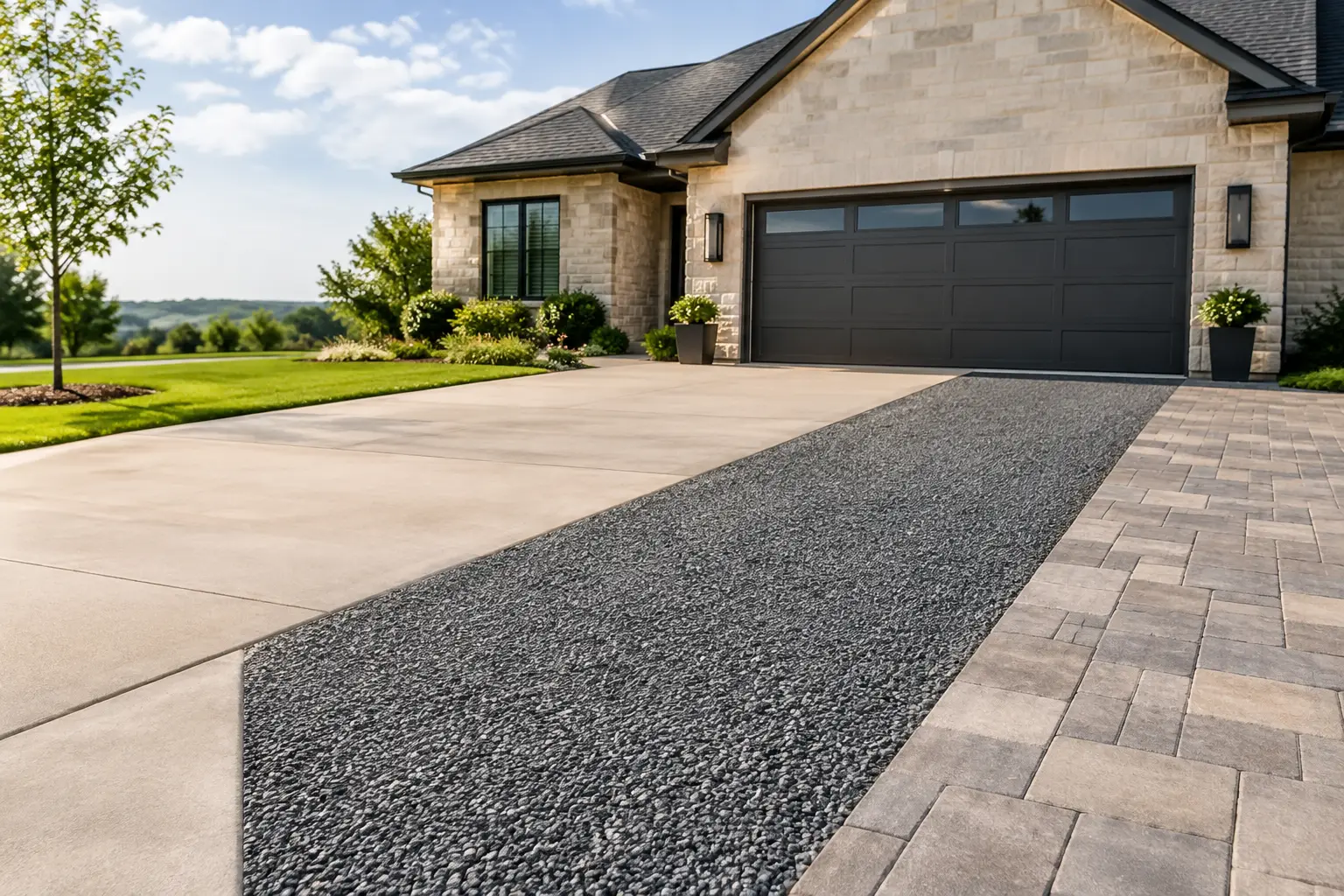
A driveway has to do more than look polished on closing day. In Central Texas, it must stand up to intense summer heat, sudden downpours, expanding clay soils, heavy vehicles, and daily use without becoming another weekend project. The best low maintenance driveway materials balance that reality with your home’s style, budget, drainage needs, and long-term plans for the property.
For most homeowners in Austin, Leander, Cedar Park, Georgetown, Lakeway, and Liberty Hill, concrete is the practical front-runner. But it is not the only strong choice. Pavers, asphalt, gravel, and permeable systems each solve different problems, and the right answer depends on how your property performs after a hard rain as much as how it looks from the street.
What Low Maintenance Really Means for a Driveway
A low-maintenance driveway is not a driveway that never needs attention. Every exterior surface needs periodic cleaning, drainage checks, and repair when damage appears. The difference is how often those tasks arise, how disruptive they are, and whether a small issue can be repaired before it turns into a major replacement.
In Central Texas, low maintenance starts beneath the finished surface. Much of the region has expansive clay soil that shrinks during dry spells and swells when moisture returns. Poor base preparation, inadequate grading, or water directed toward the driveway can cause cracking, settlement, or edge failure in nearly any material. A premium finish cannot compensate for an unstable foundation below it.
The most reliable projects consider vehicle weight, driveway slope, turning areas, shade, runoff from the roof, and access for delivery or work vehicles. That planning protects your investment and keeps future upkeep manageable.
Best Low Maintenance Driveway Materials Compared
Concrete: The Best All-Around Choice for Most Texas Homes
A properly installed concrete driveway offers the strongest combination of durability, clean appearance, and minimal routine care. It does not need regular resealing to remain functional, it handles heat well, and it provides a solid surface for family vehicles, guests, trash bins, and everyday foot traffic. For homeowners who want a driveway that looks intentional and performs for years, concrete is often the best value over its service life.
Standard broom-finish concrete is especially practical. Its subtle texture improves traction in wet weather and hides dust better than a highly polished surface. Decorative options such as exposed aggregate, light broom finishes, borders, and integral color can elevate curb appeal without adding the maintenance burden of more delicate materials.
Concrete does have trade-offs. It can crack, particularly when the ground moves or control joints are poorly planned. Repairs are durable when handled correctly, but a patch may remain visible. Sealing is optional for basic performance, though a quality sealer can help protect decorative concrete from stains and weathering. The key is professional site preparation, correct slab thickness, reinforcement where appropriate, thoughtful joint placement, and drainage that moves water away from the slab.
Interlocking Pavers: Premium Appearance With Repair Flexibility
Interlocking concrete pavers are a compelling option for homeowners who want a more custom, design-forward driveway. They come in a wide range of colors, sizes, patterns, and edge details, making them a natural fit for luxury homes, outdoor living upgrades, and properties with distinctive architecture.
Their greatest maintenance advantage is repairability. If a localized area settles because of soil movement or a utility repair is needed, individual pavers can be lifted, the base can be corrected, and the surface can be reset. That is a major benefit over a large concrete slab, where movement can create a more permanent visual crack.
Pavers require more initial precision and typically carry a higher upfront cost. Joint sand may need replenishing over time, and shaded or damp areas can develop algae or weeds if neglected. Polymer-enhanced joint sand and proper edge restraints reduce those concerns. For homeowners willing to perform occasional surface cleaning and periodic joint maintenance, pavers deliver a high-end look with practical long-term serviceability.
Asphalt: Functional, But More Demanding Over Time
Asphalt remains a familiar choice for long rural driveways and properties where initial installation cost is a major concern. It is flexible, which can help it tolerate minor ground movement, and its dark surface creates a simple, uniform appearance.
However, asphalt is not typically the lowest-maintenance material for Central Texas homes. UV exposure and high temperatures gradually dry the binder, while water intrusion can lead to cracking and soft spots. It generally benefits from sealcoating every few years, along with timely crack filling. In hot weather, heavy loads can also leave marks in softer asphalt.
Asphalt can still make sense for a large driveway where budget and speed are priorities, especially if the owner accepts a regular maintenance schedule. For a primary residence focused on lasting curb appeal and minimal upkeep, concrete usually has the edge.
Gravel: Low Cost, Not Low Attention
Gravel driveways can look attractive on acreage, ranch-style properties, and rural lots. They drain well when built with the right base, are relatively affordable to install, and can be expanded easily as parking needs grow.
The misconception is that gravel is maintenance-free. Vehicle traffic pushes stone out of place, creates ruts, and carries gravel into lawns and streets. Over time, the surface needs fresh material, reshaping, and compaction. Weeds can also become a concern when the base and fabric layers are not installed correctly.
Gravel is a good fit when a relaxed, natural aesthetic is part of the property’s character and ongoing grading is acceptable. It is less ideal for homeowners who want a clean, finished arrival experience without periodic attention.
Permeable Pavers and Grid Systems: Smart for Drainage-Sensitive Sites
Permeable driveways are designed to let rainwater pass through the surface and into a prepared stone base below. Options include permeable interlocking pavers, open-cell concrete grids, and reinforced gravel systems. They can be particularly useful where runoff management is a concern or where preserving a more natural drainage pattern matters.
These systems are not automatically maintenance-free, but they can be highly effective when engineered for the site. The surface must be kept reasonably clear of sediment and debris so water can continue to infiltrate. Some systems also need occasional vacuuming or joint material refreshment.
For a property with drainage challenges, a permeable system may reduce water problems that would otherwise create expensive maintenance elsewhere. This is a case where the best material is not simply the hardest surface. It is the one that works with the land.
How to Choose the Right Material for Your Property
The best choice often becomes clear when you weigh four practical questions: how the driveway will be used, how water moves across the property, how much design flexibility you want, and what level of future upkeep feels reasonable.
A family home with multiple vehicles, regular guests, and a garage-forward layout usually benefits from concrete. A custom home with a formal entry, curved drive, or outdoor living area may justify pavers for their visual impact and repair flexibility. A long private lane may favor asphalt or gravel, depending on budget and the owner’s willingness to maintain it. A site with concentrated runoff or drainage restrictions may call for a permeable solution designed around the property’s grading.
Color also deserves more attention than many homeowners expect. Dark surfaces absorb more heat, which can make a driveway uncomfortable to walk on during summer and contribute to faster aging in asphalt. Lighter concrete tones tend to stay cooler and complement the limestone, stucco, brick, and modern exterior palettes common across Central Texas.
Installation Quality Matters More Than the Material Alone
Even the best driveway material can underperform when the installation overlooks soil conditions or water management. A driveway should be evaluated as a complete system: subgrade, compacted base, thickness, reinforcement, joints or edge restraints, slope, and drainage paths.
For example, adding concrete over an unstable or poorly compacted base may produce early cracking. Installing pavers without proper edge restraints can allow the pattern to spread. Directing downspout discharge onto any driveway can wash out supporting material or create staining and erosion. These are construction details, but they directly affect how much maintenance your driveway will require.
That is why a site-specific assessment matters before selecting a finish. NXT Construction Inc. approaches driveway projects with the same care as any lasting property improvement, considering how the work supports your home, lifestyle, and long-term value rather than treating it as a simple surface replacement.
Simple Habits That Extend Driveway Life
Once your driveway is installed, routine care should be straightforward. Sweep away leaves and soil so moisture does not sit against the surface. Keep gutters and downspouts from emptying directly onto the driveway. Clean oil or automotive fluid spills promptly, especially on concrete and pavers. If you notice a crack, low spot, loose paver, or drainage change, address it early while the repair is still targeted.
Avoid using harsh de-icing chemicals if a rare freeze arrives, and be careful with metal-edged tools that can chip or scar decorative finishes. For pavers, occasional joint-sand maintenance and gentle cleaning will preserve both appearance and stability. For concrete, a professional evaluation can determine whether resealing or crack repair is worthwhile before damage progresses.
A well-built driveway should make daily life easier, not create another maintenance list. Choose a material that suits the way you use your property, invest in sound preparation below the surface, and you can enjoy a durable entry that continues to add value every time you pull home.