
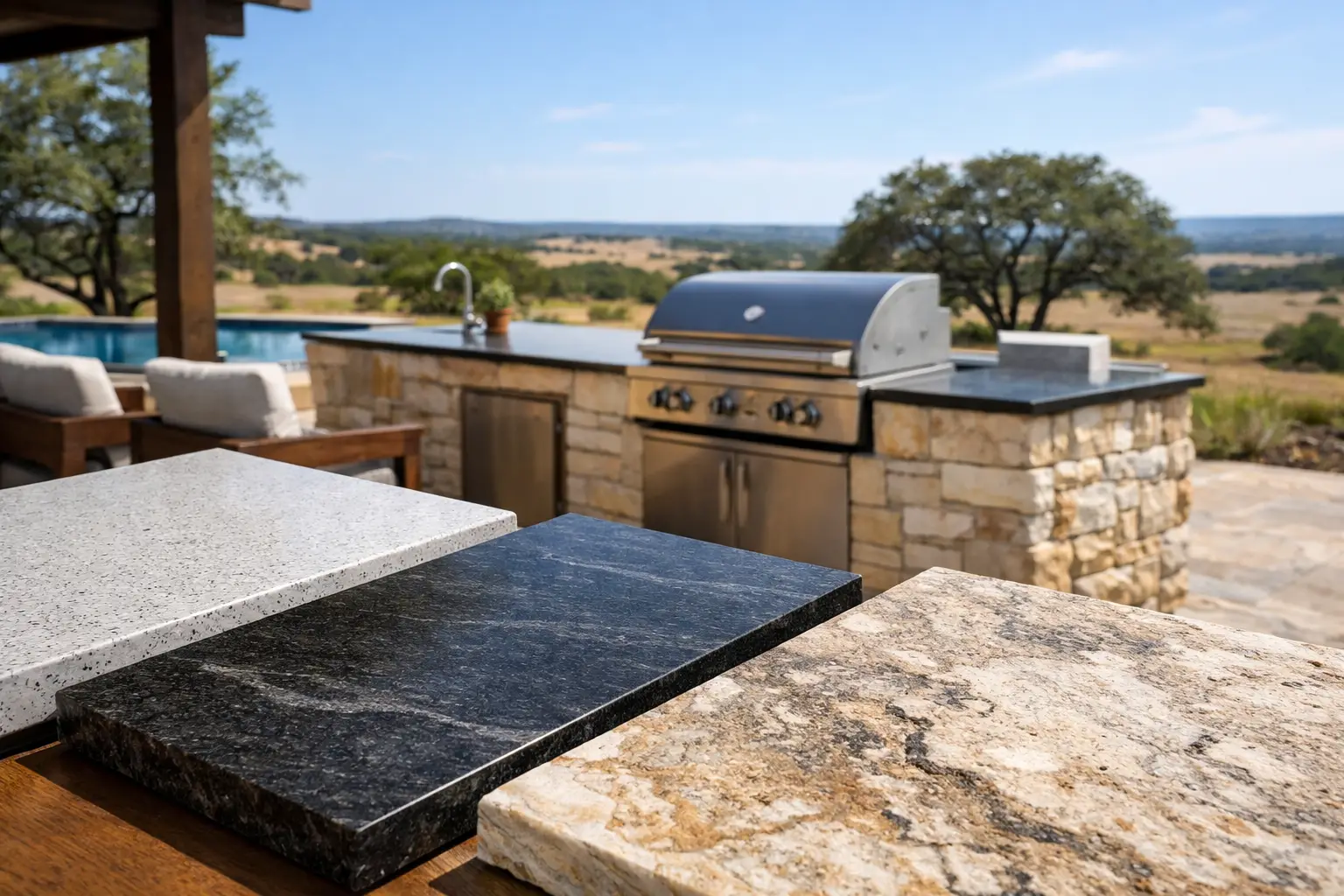
A Central Texas outdoor kitchen can go from sunny brunch to a sudden downpour before the grill has cooled. That is why choosing the best materials for outdoor countertops is about more than finding a color you love. Your countertop needs to handle intense UV exposure, high summer temperatures, windblown dust, grease, moisture, and the daily wear of gathering with family and friends.
The right choice depends on how you use the space, where it sits on the property, and how much maintenance you are comfortable taking on. A countertop beneath a covered patio has different needs than one exposed to full afternoon sun in Austin, Lakeway, or Georgetown. The strongest outdoor kitchens balance visual impact with practical performance from the start.
What an Outdoor Countertop Must Handle in Central Texas
Indoor countertop rules do not automatically apply outside. Heat can cause certain materials to expand, fade, or crack. Water can enter unsealed edges and joints. Direct sun can make dark surfaces uncomfortably hot, while freezing weather, although less frequent here, can still affect porous materials and poorly installed assemblies.
Material selection also has to work with the construction below it. A heavy natural-stone slab needs a properly engineered base. Wood-framed islands require waterproofing and exterior-rated finishes. Concrete needs thoughtful reinforcement, control joints, and curing. The countertop is the visible finish, but its long-term success begins with the structure supporting it.
Best Materials for Outdoor Countertops: Top Choices
Granite: A Proven Outdoor Kitchen Favorite
Granite remains one of the most dependable choices for outdoor countertops. It is a natural stone with excellent heat resistance, good scratch resistance, and a substantial look that works beautifully with masonry, stucco, steel, and wood pergolas. Every slab has natural variation, giving a built-in outdoor kitchen a custom feel rather than a manufactured appearance.
For Central Texas projects, a lighter or mid-tone granite is often more comfortable in direct sunlight than a nearly black slab. A quality sealer is still recommended, particularly around sinks, beverage stations, and grill areas where oil, citrus, and spills are common. With periodic sealing and straightforward cleaning, granite can provide years of service.
The trade-off is that granite is heavy and natural slabs can have fissures or color variation. Those are not necessarily defects, but they should be discussed before fabrication. Choosing the actual slab instead of relying on a small sample helps align the finished result with your expectations.
Porcelain Slabs: Clean Design With Serious Performance
Porcelain slab countertops are increasingly popular for modern outdoor kitchens, especially for homeowners who want a refined, low-maintenance surface. High-quality porcelain is nonporous, resists staining, performs well around heat, and does not require routine sealing. It is also highly resistant to UV fading, making it a strong option for exposed patios.
Porcelain comes in an impressive range of looks, including concrete-inspired finishes, natural stone patterns, and soft neutral colors. It can create a clean, contemporary outdoor kitchen without asking you to accept the maintenance of a porous surface.
Installation matters greatly. Porcelain slabs are durable, but their edges can chip if they are poorly handled or unsupported. A qualified fabricator and an accurately prepared base are essential. It is usually a higher-investment option, but its performance and easy upkeep can make that investment worthwhile for a frequently used entertaining space.
Concrete: Fully Custom and Built for the Design
Concrete gives homeowners uncommon creative freedom. It can be cast to almost any length or shape, making it useful for curved bars, oversized islands, integrated seating ledges, and tailored outdoor kitchen layouts. Color, texture, edge details, and finish can all be customized to complement the home and landscape.
A properly built concrete countertop can be durable and striking, but it is not maintenance-free. Hairline cracking can occur over time, particularly when the base moves or the concrete is not reinforced and cured correctly. It also needs a reliable sealer to help prevent staining and moisture intrusion.
Concrete is an excellent fit when the goal is a one-of-a-kind outdoor living area rather than a standard kitchen island. It is best approached as a craftsmanship-driven installation, not a shortcut material. Detail-oriented forming, reinforcement, finishing, and sealing determine whether it looks exceptional for years or becomes a recurring repair item.
Quartzite: Natural Beauty With Outdoor Strength
Quartzite is a natural stone prized for its layered movement, sophisticated color variation, and strong resistance to scratching and heat. It can offer the elevated look many homeowners associate with luxury indoor kitchens while holding up well in an outdoor setting when properly selected and sealed.
There is one important point of clarity: quartzite is different from engineered quartz. True natural quartzite can be a suitable outdoor material. Engineered quartz, which contains resins and pigments, is generally not recommended for full outdoor exposure because UV light and extreme heat can cause discoloration or other performance issues.
Quartzite is typically more expensive than granite, and some varieties are more porous than others. If you love the material, review the specific slab, ask about sealing requirements, and choose a fabricator familiar with exterior applications. The result can be a dramatic surface that connects an outdoor kitchen to the quality of the home’s interior finishes.
Stainless Steel: The Commercial-Grade Option
For homeowners who prioritize a true chef-style setup, stainless steel is a practical outdoor countertop material. It is nonporous, sanitary, heat-resistant, and unaffected by rain. It pairs naturally with built-in grills, refrigerators, smokers, and modern architecture.
Its primary drawback is appearance over time. Stainless can show fingerprints, water spots, and scratches, especially in a busy cooking area. In direct sun, it can also become very hot to the touch. A brushed finish is generally more forgiving than a polished one, and stainless works especially well for a dedicated prep zone rather than every surface in a large outdoor kitchen.
Materials That Need Extra Caution Outside
Some familiar indoor materials require careful consideration before they are installed outdoors. Engineered quartz is one of the biggest examples. It may look ideal in a showroom, but its resin content can make it vulnerable to direct sunlight and heat. A covered, screened space may reduce that risk, yet natural stone or porcelain is often the safer long-term decision.
Marble creates a classic, high-end look, but it is softer and more reactive than granite or quartzite. Acidic foods, wine, and oils can etch or stain the surface. It can be used outdoors for a homeowner who accepts patina as part of its character, but it is not the simplest choice for a high-traffic grill station.
Tile can be budget-friendly and offers many design options, but grout lines create more cleaning and maintenance. Outdoor-rated tile with quality grout can work well for smaller counters, backsplashes, or covered serving areas. For a large, heavily used countertop, a slab surface usually provides a cleaner, more durable result.
How to Choose the Right Surface for Your Project
Start with the location. Full-sun kitchens benefit from UV-stable materials such as granite, porcelain, concrete, or properly selected quartzite. If the kitchen is covered and protected from weather, you may have more flexibility, though heat and humidity still matter.
Next, think honestly about use. A compact patio bar used a few weekends each month can support a different material choice than a full outdoor kitchen with a sink, refrigerator, grill, and seating for ten. Families who cook outside often may value porcelain’s easy cleanup. Homeowners focused on custom architecture may prefer concrete. Those seeking natural character and lasting value often choose granite or quartzite.
Budget should include more than the slab price. Fabrication, edge profiles, seams, delivery, installation, structural support, waterproofing, sealing, and appliance cutouts all affect the finished investment. A lower-cost material can become expensive if it requires frequent repairs, while a higher-quality surface can protect both your enjoyment and property value over time.
Installation Details That Protect Your Investment
Even the best countertop material can fail when the installation is treated as an afterthought. Outdoor counters need stable, level bases designed for the slab weight and appliance layout. Water should be directed away from cabinets and structural framing. Seams and penetrations around sinks or grills need proper attention, and expansion must be considered where materials meet.
This is where a full-service outdoor living contractor adds real value. NXT Construction Inc. plans the countertop alongside the patio, utilities, masonry, shade structures, drainage, and cooking equipment, so the finished space feels intentional and performs as one system. The goal is not simply to install a surface. It is to build an outdoor destination that fits the way you live.
The best choice is the one that still looks and works beautifully after a hot August, a busy football weekend, and years of meals shared outside. Choose the material with your lifestyle, exposure, maintenance expectations, and construction plan in mind, then give it the installation quality it deserves.




One Response