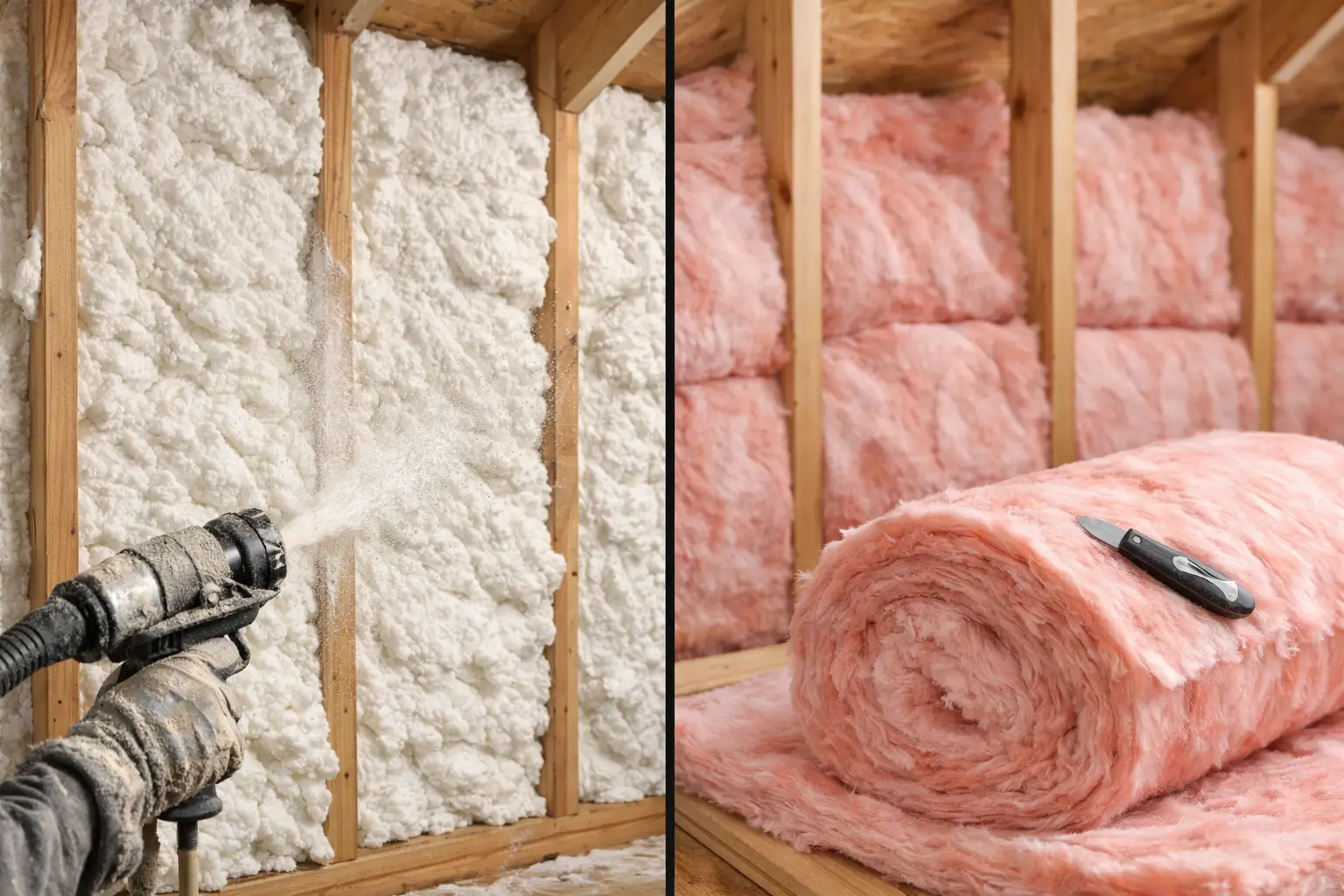
A Central Texas attic can reach punishing temperatures for much of the year, and the insulation choice below that roof affects far more than a monthly utility bill. When comparing spray foam versus fiberglass insulation, homeowners are really deciding how their home will manage heat, humidity, air leakage, noise, and long-term maintenance.
Neither material is automatically the right answer for every home. A practical choice depends on the age of the structure, the condition of the attic, whether HVAC equipment and ductwork are located overhead, the project budget, and the performance goals behind a remodel, addition, or new build. The best insulation plan is one designed around the whole building rather than one product alone.
Spray Foam Versus Fiberglass Insulation: The Core Difference
Fiberglass insulation slows heat transfer with fine glass fibers that trap pockets of air. It is commonly installed as batts between wall studs and ceiling joists or blown across an attic floor. It has been a standard residential insulation material for decades because it is accessible, familiar, and cost-effective.
Spray foam is applied as a liquid that expands and hardens in place. Open-cell spray foam expands dramatically and remains softer, while closed-cell foam is denser, more rigid, and more resistant to moisture. Both types can fill irregular cavities, gaps, and penetrations that are difficult to address with traditional batts.
The central distinction is air movement. Fiberglass insulates effectively when installed correctly, but it does not stop air leakage on its own. Spray foam can provide insulation and air sealing in a single application. In a hot climate where attic heat, humid outdoor air, and leaky duct connections can all affect indoor comfort, that difference can be significant.
How Each Option Performs in Central Texas Homes
Heat control and energy efficiency
Fiberglass can deliver strong thermal performance when it is installed at the proper depth and is not compressed, wet, or interrupted by gaps. For many homes, blown fiberglass across an attic floor is a sensible way to increase R-value and improve comfort without a major renovation.
Spray foam typically provides more insulating value per inch, especially closed-cell foam, but its most meaningful advantage is reducing uncontrolled airflow. Air sealing can help rooms stay more consistent from morning to evening and reduce the load on heating and cooling equipment. This matters in homes with complicated rooflines, recessed lighting, plumbing penetrations, or ductwork in unconditioned attic space.
If a home has a conventional vented attic and the HVAC system is located inside the conditioned living area, upgrading and air sealing the attic floor with fiberglass may offer excellent value. If ducts and mechanical equipment sit in the attic, applying spray foam to the roof deck can bring that attic into the conditioned envelope, protecting the equipment from extreme heat.
Moisture and indoor air considerations
Central Texas humidity is not the same as a Gulf Coast climate, but moisture management still deserves careful planning. Closed-cell spray foam resists water vapor and can add rigidity to certain assemblies. It is often considered where space is limited or a higher level of moisture resistance is needed.
Open-cell foam is more vapor-permeable and can be appropriate in properly designed attic and wall assemblies. Because it is softer, it may allow a roof leak to become visible rather than keeping moisture hidden behind a dense layer. That does not eliminate the need for a sound roof, proper flashing, and a construction plan that accounts for drying potential.
Fiberglass does not act as an air barrier or vapor barrier. If humid air moves through poorly sealed gaps and reaches a cold surface, condensation can occur. Fiberglass can also lose performance when wet or compressed. With either material, the surrounding details matter: roof condition, ventilation strategy, HVAC sizing, bath exhaust routing, and air sealing must work together.
Comfort and sound control
Homeowners often notice insulation problems as comfort problems first. A second-story bedroom that overheats, a home office that feels drafty, or a bonus room that never matches the thermostat setting can point to gaps in the thermal envelope.
Spray foam can improve comfort by limiting air movement around framing, wiring, and penetrations. Open-cell foam also provides useful sound reduction, which can be valuable for home offices, media rooms, bedrooms, and shared walls.
Fiberglass can also offer good sound absorption, particularly in interior walls. For a remodel where the priority is reducing conversation or plumbing noise between rooms, fiberglass batts may be a practical, budget-conscious choice. Insulation alone will not fully soundproof a room, however. Wall assembly design, drywall layers, doors, ducts, and electrical openings all influence the result.
Cost: Upfront Price Versus Long-Term Value
Fiberglass generally costs less to install than spray foam. That lower upfront cost can make it the better fit for a homeowner who needs a straightforward attic upgrade, a basic wall insulation solution, or a cost-controlled project with accessible cavities.
Spray foam requires specialized equipment, trained installers, and more preparation, so its initial investment is higher. The long-term value can be compelling when air leakage is a major issue, when attic ductwork is exposed to extreme temperatures, or when a renovation gives access to hard-to-reach cavities that should be sealed correctly before finishes go back in place.
The right comparison is not simply material price per square foot. Consider whether insulation will reduce hot and cold spots, protect HVAC performance, improve usable space, support a quieter home, or avoid future rework. A low-cost installation that leaves major air gaps can be more expensive over time than a carefully planned system that addresses the actual source of discomfort.
Installation Quality Can Decide the Outcome
Even premium insulation will underperform if it is installed without attention to the surrounding assembly. Fiberglass batts need to fit snugly without being compressed or left with gaps around outlets, pipes, and framing. Blown fiberglass needs consistent depth, especially near attic edges and access points.
Spray foam must be applied at the right thickness and allowed to cure under appropriate conditions. It also needs to be selected for the correct location. A roof-deck application changes how an attic behaves, which may affect ventilation, combustion-air requirements, HVAC design, and code-required ignition or thermal barriers.
Before choosing either product, a contractor should evaluate the attic or wall cavity, identify existing moisture concerns, inspect ducts and penetrations, and understand the homeowner’s goals. This is especially important during additions, garage conversions, ADU construction, and whole-home remodeling, where insulation decisions are much easier to get right before drywall and finishes are installed.
When Fiberglass Is Often the Better Choice
Fiberglass can be the right answer when the attic floor is accessible, the home will retain a vented-attic design, and the main objective is adding R-value at a controlled cost. It is also well suited for interior wall cavities where sound absorption matters and no air-barrier function is required from the insulation itself.
It can be an efficient solution for investment properties, targeted repairs, and projects where the budget is better directed toward roof repairs, duct sealing, windows, foundation work, or other higher-priority improvements. The key is pairing it with proper air sealing where needed rather than expecting fiberglass alone to solve every comfort issue.
When Spray Foam Is Worth Considering
Spray foam is often worth the investment in homes with attic HVAC equipment, complex roof geometry, substantial air leakage, or rooms that struggle with heat gain. It can also make sense in new construction and major renovations, where creating a tighter building envelope supports a more intentional approach to comfort and energy use.
Closed-cell foam may be selected where its higher R-value per inch and moisture resistance serve the assembly. Open-cell foam may be selected for larger roof-deck areas where air sealing and sound control are priorities. The decision should be based on the building’s needs, not a one-size-fits-all preference.
For Central Texas property owners, insulation is a performance decision that affects how a home feels every day. A thoughtful inspection can reveal whether your biggest opportunity is more attic insulation, better air sealing, an encapsulated attic, duct improvements, or a combination of measures. NXT Construction Inc. can help turn that assessment into a plan that respects your budget while building toward a more comfortable, durable property.